The Honeycomb Principle: Nature, Matter and Design
What a hexagon can save in wall length, and what that leaves open about wax combs and engineered panels.
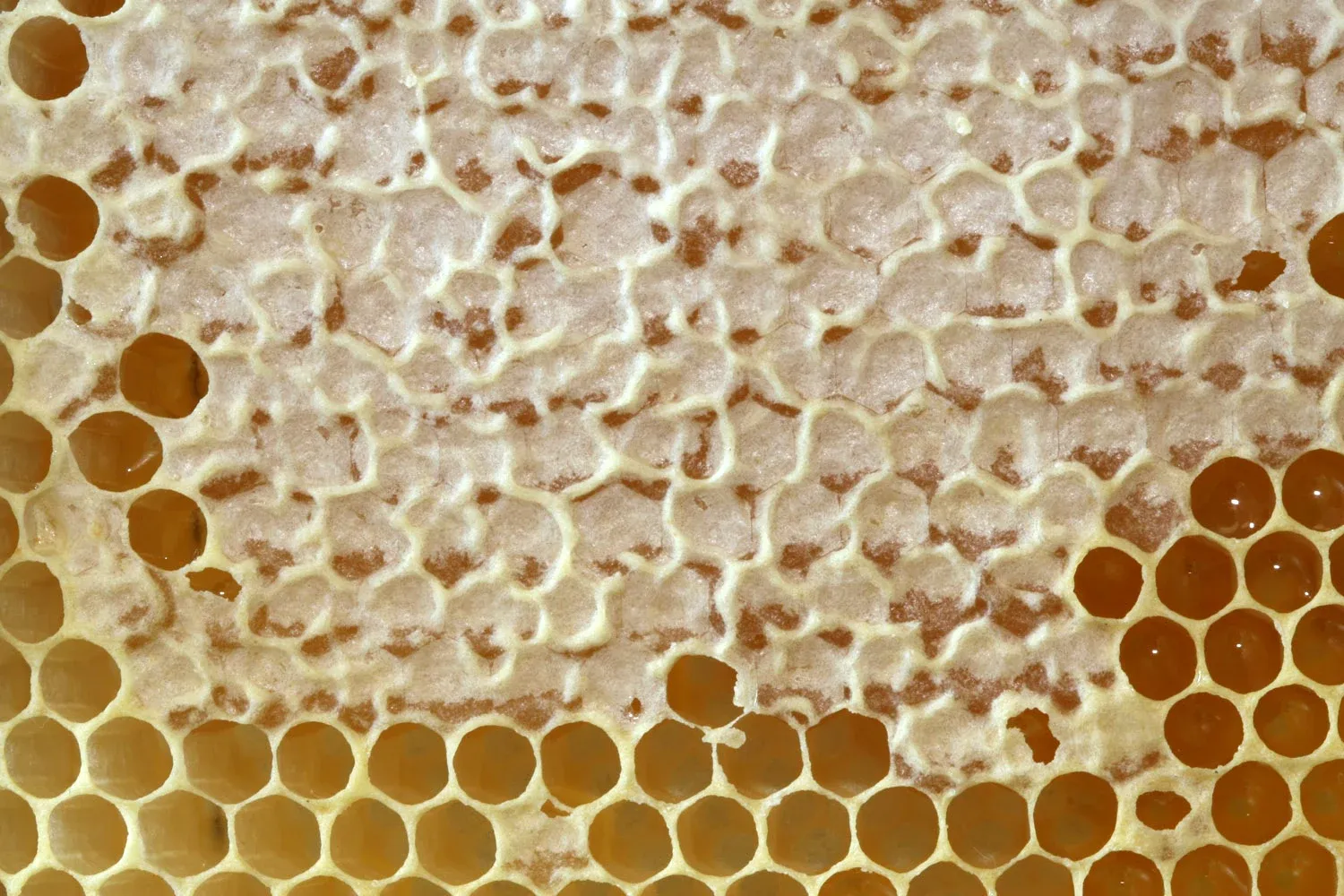
Stand close enough to a honeycomb and the repeated cells start to look less like holes and more like a connected network of walls. An edge between two cells serves them both. At each junction a wall branches toward the next cell, and a little farther away the arrangement repeats.
That shared boundary suggests a mathematical question. If a plane is to be divided into equal areas, how little boundary length can we use? It also suggests two further questions that call for other kinds of evidence. How do bees build this structure? How does a panel with a cellular core carry a load?
The geometry of shared edges
Regular triangles, squares and hexagons can each tile a plane by themselves. For cells of the same area, the regular hexagon has a shorter perimeter than either the square or the equilateral triangle. Thomas Hales proved a stronger result. The regular hexagonal tiling minimizes perimeter for a partition of the plane into regions of equal area under the theorem’s conditions.
The problem concerns a flat partition. It does not specify wall thickness, the bottom shape of a cell or how to start building at a ragged edge. Those details matter when the partition becomes a physical object.
The comb has seams
In actual comb, the arrangement sometimes has to accommodate two groups of cells that meet at different angles or have different sizes. A study by Smith, Napp and Petersen documented transitions where honeybees built cells of varying sizes and shapes, including cells with a number of sides other than six. The seams are places to observe how a mostly regular structure handles irregular conditions.
Look again at the wax walls in the photograph. The scale and framing tell you more about the texture and coverage than about the plan of an entire comb. The photograph records an actual object, while a drawing of equal hexagons lets us isolate a rule. The two images answer different questions.
Two faces and a core
Engineered sandwich panels can use a lightweight cellular core bonded between thin face sheets. The separation between those faces helps the panel resist bending. The core and the bonds contribute to how loads move through the panel. Cell shape is one design variable among others, alongside the materials, orientation, thickness and expected loading.
In the comparison, look for the shared walls first, then turn on the annotation for a face sheet. A top view makes the comb and panel core seem similar. A cutaway adds the faces and shows where the two structures diverge. An equal-area perimeter proof describes the tiling, while a test of a physical panel has to account for the full assembly.
Figure 02 · Comparison
From wax walls to a structural core
Wax comb A plan view simplified to equal cells.
Sandwich panel The core separates and supports the face sheets.