The Architecture of Repetition
At the Salk Institute, repeated study towers give shape to a courtyard and direct the eye toward the ocean.
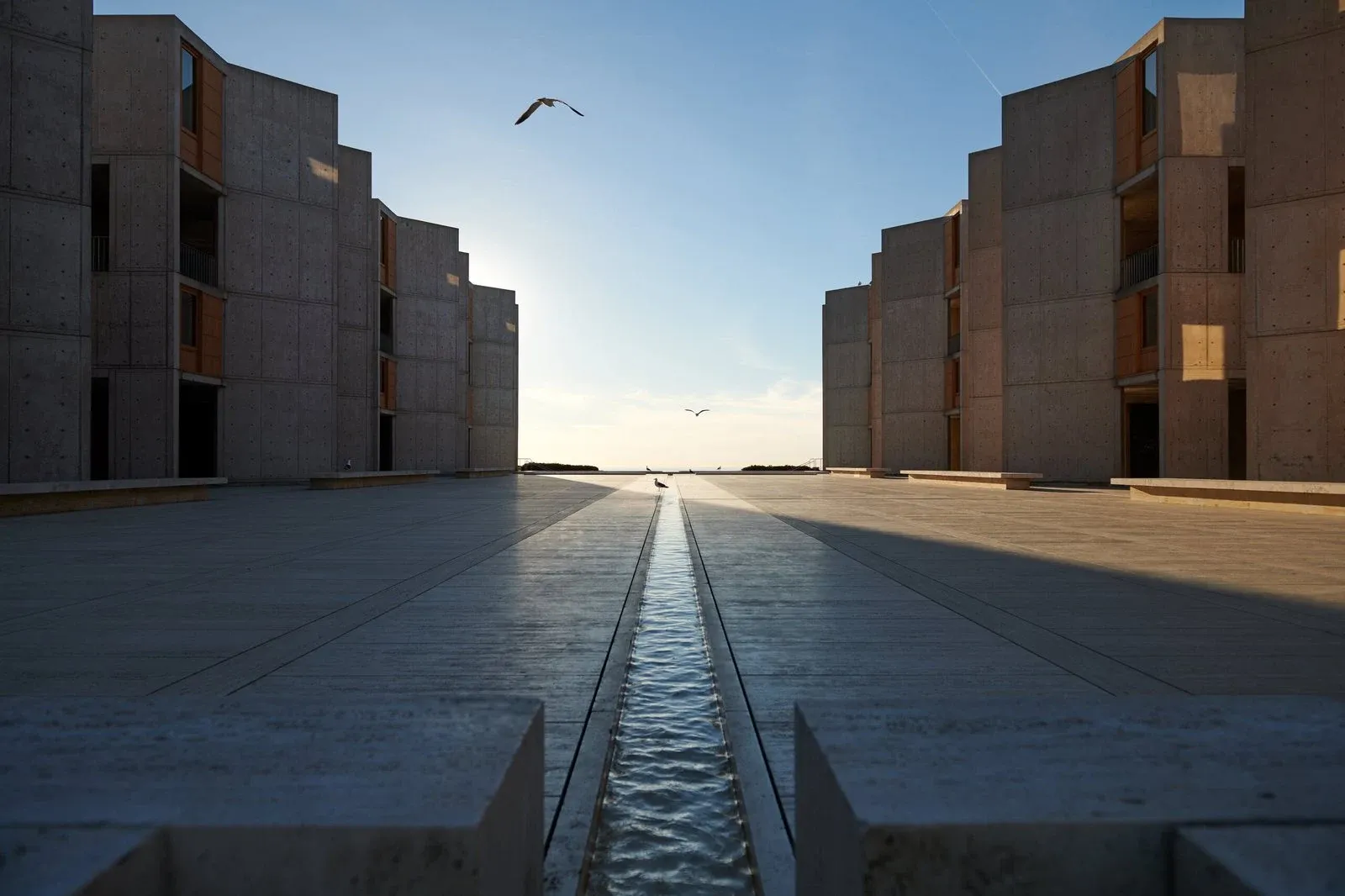
At one end of the Salk Institute courtyard, a narrow water channel leads the eye between two concrete buildings and out toward the Pacific. There is a strong central axis, but look to either side and another pattern appears. Study towers project into the courtyard at regular intervals. Seen at an angle, each one adds another turn to a long, sawtoothed edge.
Architect Louis Kahn set two mirror-image structures on either side of the courtyard. This creates two kinds of repetition at once. The towers recur along its length, and the buildings answer one another across the central axis. The two patterns are easy to identify in a photograph, even though perspective makes each distant tower appear narrower than the one before it.
A bay is an interval
In architecture, a bay can be the interval between structural elements or recurring divisions in a façade. The word is useful because our eyes readily group a building into intervals even when the structural scheme is hidden. A row of windows suggests a bay. A gap in the row suggests a different room, a stair or simply a change of emphasis. The image on its own rarely settles which.
At the Salk, the projecting towers house studies. The institute’s guide describes how their angled arrangement affords views of the ocean and the plaza. The rhythm visible from the courtyard has consequences for someone sitting inside. A projection gives a room a different relationship to the outside than it would have in a long, flush wall.
Shadows are part of the reading
As light moves across the courtyard, the recesses and projections become easier or harder to distinguish. A shadow can make one tower seem deeper than the next, even if the repeated forms share the same dimensions. This is one reason a building feels different in person and at different hours. Its geometry has stayed put. The information reaching the eye has changed.
Imagine redrawing the photograph with a single line at each projecting edge. The result would show a cadence but lose the changing width of shadows, the roughness of concrete and the sky at the far end. That spare drawing could answer a question about spacing. The photograph can answer a different one about how the spacing is experienced.
Where to look for the design
Try beginning at the center of the courtyard, then trace one side with your eye. Notice the points where the shape repeats and the places where the sequence has to begin or end. At each break, ask what the change does. It might mark the edge of a building, open a view, or separate one kind of room from another. The comparison between those moments and the regular intervals in between reveals much of what the designer had to resolve.